Mod 3 Assimilation Through Education
Assimilation Through
Education: Indian Boarding Schools in the Pacific Northwest
The
source I reviewed for Mod 3 is called Assimilation Through Education: Indian
Boarding Schools in the Pacific Northwest by Carolyn J. Marr. I find this source credible because it is the University of Washington Library. During the 1880's
to the 1920's, the goal of Indian education was to assimilate Indian people into
white Americans. This was done by placing Indians into institutions that were
intended to replace their traditions with ones sanctioned by the government.
Federal Indian policy allowed the removal of Indian children from their
families. These children were enrolled in a government run boarding school.
Policy makers believed that young people would be engaged in the values and
knowledge of what was considered a dominant American society. All the while the
Indian children were being kept away from any inspirations conveyed by their
traditional family members. https://content.lib.washington.edu/aipnw/marr.html#study
Reformers
were convinced that with the correct education Indians could become more like
white Americans. “They convinced the leaders of Congress that education could
change at least some of the Indian population into patriotic and productive
members of society” (Marr 1). Carlisle Indian School in Pennsylvania, founded
by Captain Richard Henry Pratt in 1879, was one of the first attempts s to
accomplish this objective. These schools seemed military like in nature if you
ask me (See the sample schedule below). Pratt believed that the Indian traditions were inferior to the ways of
the white man. Pratt endorsed the principle, ‘kill the Indian and save the man’
(Marr 1). That was a common belief among many misguided individuals. I’m not
opposed to anyone furthering their education at their own will. However, to
force anyone into an education in an attempt to make them conform to traditions
and ways other than their own is disheartening.
Runaways
were punished severely, and were often examples for their fellow peers. Chronic
illness was a serious problem in these boarding schools. The boarding schools
were crowded and lacked medical care. This was a contributing factor of
spreading diseases such as measles, influenza and tuberculosis. “Tuberculosis
was especially feared and at the Tulalip Indian School the dormitories were
kept cold by leaving the windows open at night” (Marr 1).
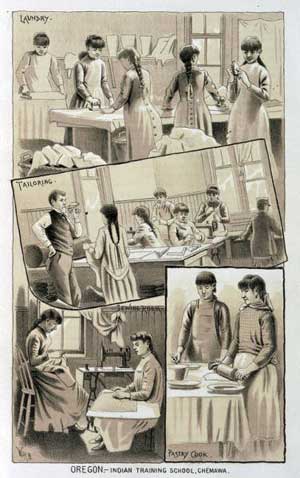
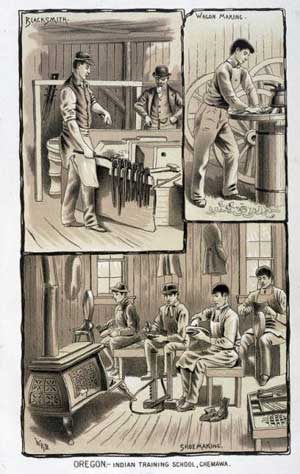
Indian Training School girl activities Indian
Training School boy activities
Sample Daily Routine
Cushman Indian School,
Tacoma, Wash.
February 1, 1912
Monday
|
5:45 A.M.
|
Reveille.
|
|
5:55 to 6:10
|
Setting Up Exercise
& Drill.
|
|
6:12
|
Air Beds.
|
|
6:12 to 6:45
|
Recreation.
|
|
6:45
|
First Call for
Breakfast.
|
|
6:55
|
Assembly. Roll Call.
|
|
7:00
|
Breakfast.
|
|
7:30 to 7:35
|
Care of teeth.
|
|
7:35 to 7:40
|
Make beds.
|
|
7:40 to 7:55
|
Police Quarters.
|
|
7:55
|
Industrial Call.
|
|
8:00
|
Industrial work begins.
School detail at liberty. The use of this period is at pupils' discretion.
The more studious at books; those inclined to athletics make use of this time
for practice. Some pupils practice music lessons, etc.
|
|
8:50
|
First School Call. Roll
Call and Inspection.
|
|
9:00
|
School.
|
|
11:30
|
Recall. Pupils at
liberty.
|
|
11:55
|
Assembly and Roll Call.
|
|
12:00
|
Dinner.
|
|
12:30
|
Recreation.
|
|
12:50
|
School and Industrial
Call. Inspection.
|
|
1:00 P.M.
|
Industrial work and
School.
|
|
3:30
|
School dismissed.
School detail at liberty. Time spent in same general manner as morning detail
utilizes period from 8:00 to 8:50.
|
|
4:30
|
Industrial recall.
Drill and Gymnasium classes.
|
|
5:15
|
First Call.
|
|
5:25
|
Assembly. Roll Call.
|
|
5:30
|
Supper.
|
|
6:00
|
Care of teeth.
|
|
6:10
|
Recreation.
|
|
7:15
|
First Call.
|
|
7:25
|
Roll Call. Inspection.
|
|
7:30
|
Lecture. This period
varies in length. Men prominent in education or civic affairs address the
pupils.
|
|
8:15
|
Call to Quarters. Older
pupils prepare lessons; intermediate children play.
|
|
8:45
|
Tattoo. Pupils retire.
|
|
8:55
|
Check.
|
|
9:00
|
Taps.
|

This was a hard one to read for me. Prior to this course, I had no idea the harsh treatment the native children experienced.
ReplyDeleteReading the of their day to day agenda reminded me of a prison. They were told to cut their hair, not speak their native language and disregard their Indian names and assume English names.
I read about the poor living conditions and infection, due to overcrowding.
https://exhibits.library.gsu.edu/current/exhibits/show/health-is-a-human-right/displacement/american-indian-boarding-schoo
Yes, this was a hard topic to not only read about, but it was difficult to write about as well. However, not reading and/or writing about it makes it seem like this was acceptable behavior. It clearly was not, and it's time to take ownership and responsibility for these actions.
DeleteI agree that what native children experienced during that time period was uncalled for. Many times, they were taken away from their families and never to be seen again. I mentioned in my post that while there are laws in place to protect native children, enforcing the law is another story. We need to keep in mind that Native Americans still fight for their rights today.
ReplyDeleteYes, I do recall reading that laws were in place to protect Native children, but enforcing them was a whole different story.
ReplyDeleteForced assimilation through the use of boarding schools was a policy that was meant to remove native culture form the landscape of America. These children were taken from their homes, family, and traditional culture and forced to try and become white Christian Americans. Even after successfully completing the time at these schools they were still discriminated against by the society that was trying to change them and when they returned to their native homes they were often treated as outsiders. This policy was a failure for both the children of Indian nations and the American society that was attempting to remove them from their traditional culture. This was truly a sad and disappointing point in American history.
ReplyDelete